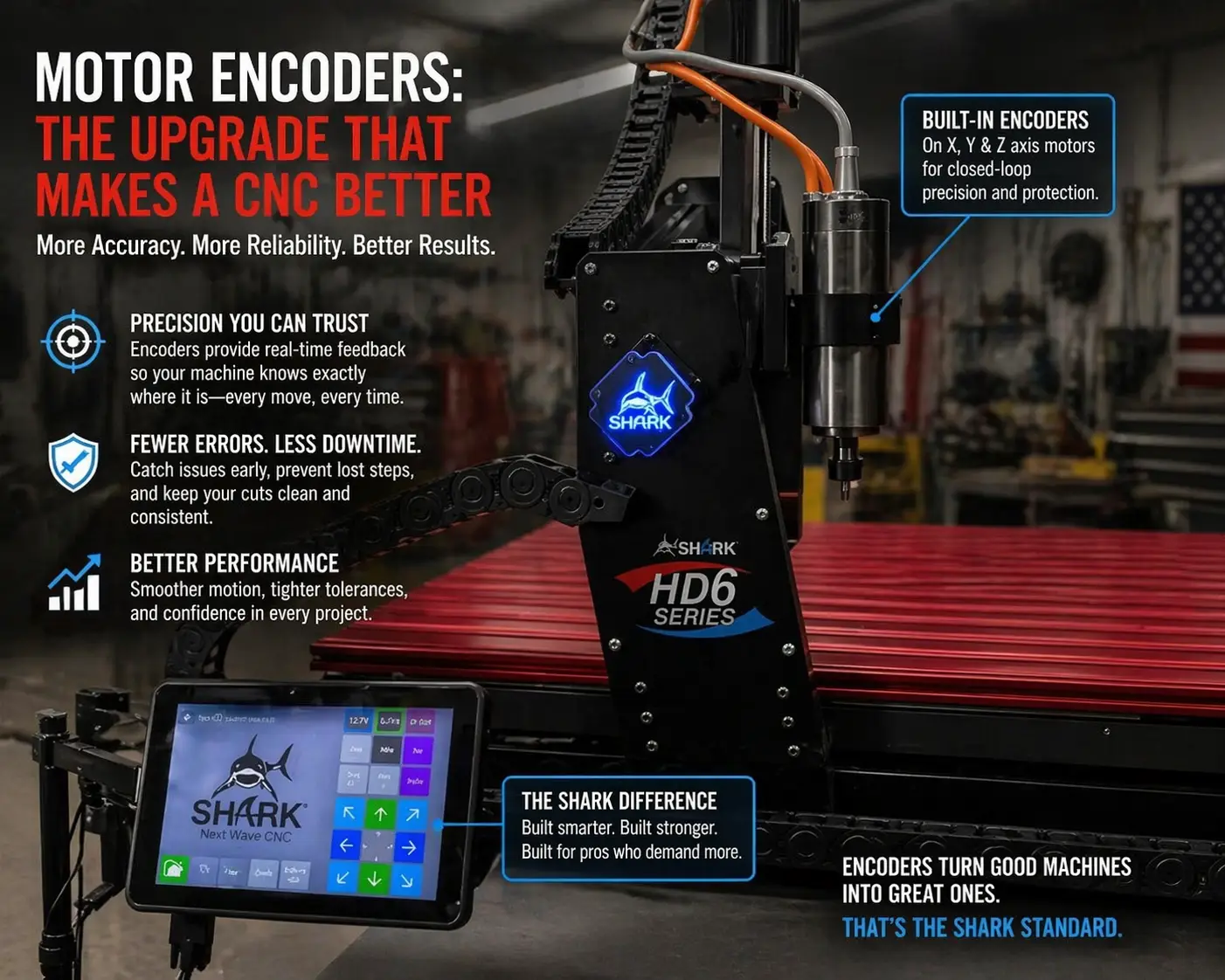
If you’re comparing CNC machines, you’ll see plenty of specs thrown around—horsepower, travel size, rigidity, controller voltage. One feature that often gets overlooked, but has a huge impact on real-world performance, is the motor encoder.
Encoders
Encoders are one of those behind-the-scenes components that quietly make a CNC machine more accurate, more reliable, and more forgiving when things don’t go perfectly—which, in machining, they rarely do.
Let’s break down what motor encoders are, what they do, and why they make a CNC better.
A motor encoder is a sensor attached to a CNC motor that continuously reports the motor’s position, speed, and direction back to the controller.
Think of it as real-time feedback.
Without an encoder, the controller simply assumes the motor moved where it was told.
With an encoder, the controller knows exactly what happened—and can correct mistakes instantly.

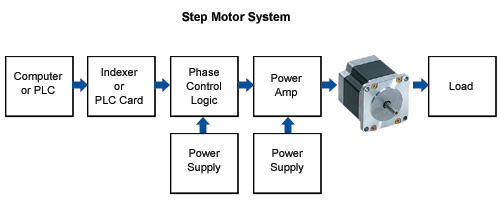
Most basic CNC machines use open-loop stepper motors:
The controller sends steps
The motor moves (hopefully)
No confirmation is sent back
If the motor:
Misses steps
Binds under load
Loses torque during aggressive cuts
👉 The machine doesn’t know—and your part can be ruined without warning.
Encoders create a closed-loop system:
The controller commands motion
The encoder verifies the movement
Errors are corrected instantly
If the motor falls behind, the system compensates—or stops and alerts the user.
Encoders ensure the cutter is exactly where the software thinks it is—especially important for:
Fine detail work
Joinery
Inlays
Multi-pass machining
Instead of hoping position is correct, the machine actively verifies it.
Lost steps are one of the most common causes of ruined CNC jobs.
Encoders:
Detect missed steps immediately
Correct position in real time
Stop and alert the user when hard stops are detected
Prevent cumulative errors that show up late in a job
This is especially valuable on:
Long runs
Heavier cuts
Harder materials
Real-world CNC work isn’t always gentle:
Knots in wood
Dense hardwoods
Tool wear
Minor workholding issues
Encoders help the CNC handle load changes without drifting off position, maintaining accuracy even when conditions aren’t ideal.
When motion stays accurate:
Toolpaths stay true
Corners stay sharp
Surfaces come out smoother
That means:
Less sanding
Less rework
More consistent results from part to part
One of the biggest benefits isn’t mechanical—it’s psychological.
Encoders give users:
Confidence to run longer jobs
Confidence to cut more aggressively
Confidence that the machine will tell you if something goes wrong
That matters whether you’re a hobbyist or running a small production shop.
Not anymore.
Encoders were once reserved for large industrial machines due to cost and complexity. Today, they’re increasingly found on high-quality small-format CNC machines designed for serious users who want:
Industrial-style reliability
Better repeatability
Fewer failed jobs
This is one of the clearest indicators that a CNC is engineered for real machining, not just light hobby use.
Encoders make the biggest difference when:
Cutting hardwoods or composites
Running longer programs
Using heavier spindles or tooling
Doing production or repeat work
Accuracy and consistency matter more than speed alone
If you’ve ever finished a job only to realize something shifted halfway through—encoders are designed to prevent exactly that.
Many encoder systems only monitor individual motor movement. Next Wave’s closed-loop system works in coordination with the controller, unlocking additional functionality:
Motor positions are monitored and controlled continuously
Small position errors are corrected automatically
When errors exceed safe limits, the machine stops and alerts the user
Hard stops are detected and communicated to the controller
The controller updates its internal position data using actual motor positions, keeping on-screen X, Y, and Z coordinates aligned with the real machine
After any hard-stop incident, it is still recommended that the user re-home the machine. However, depending on project criticality, it is possible to continue machining using skip-line recovery and speed-change functions built into the 10.1″ pendant—often with excellent results.
Motor encoders don’t make flashy headlines, but they fundamentally change how a CNC machine behaves.
They turn motion from assumed to verified, from hopeful to precise.
If accuracy, reliability, and confidence matter in your CNC work, encoders aren’t just a nice feature—they’re a smart investment.
All HD6 PRO series machines feature encoded motors.
👉 Shop HD6 PRO Series Now